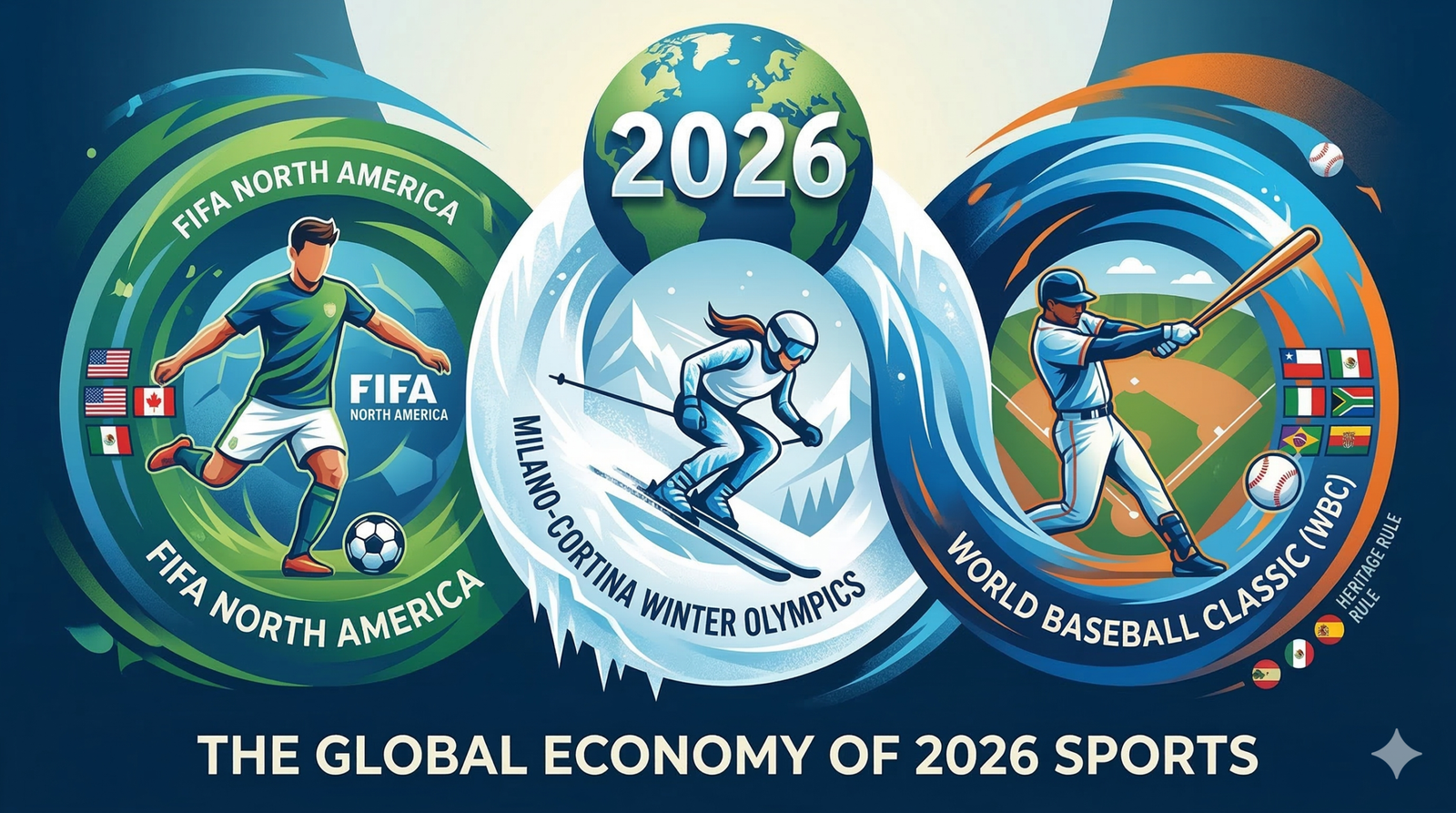
Three mega-events. Three continents. One unprecedented year for tourism, media, investment, and the cultural reach of sport. Here’s the complete breakdown.
The 2026 Sports Supercycle: Why This Year Is Unlike Any Other
Every four years, the global sports calendar delivers a blockbuster. But 2026 is something different. For the first time in modern sports history, three of the world’s highest-profile international tournaments — the FIFA World Cup, the Winter Olympics, and the World Baseball Classic — are unfolding in the same calendar year, creating what analysts are already calling the 2026 Sports Supercycle.
This isn’t just a scheduling quirk. It is a synchronized detonation of global consumer attention, a simultaneous flood of international travel, and a compounding of sponsorship, broadcasting, and merchandise revenue at a scale the industry has never seen. For businesses in hospitality, travel, media, and sports infrastructure — and for investors paying attention — 2026 represents a generational window.

Economic Impact Comparison: The Numbers Behind the Spectacle
Not all mega-events are created equal. The three events of 2026 differ dramatically in scale, audience, and the type of economic activity they generate. Here’s how they stack up.
| Event | Dates | Host Region | Economic Impact | Visitors | Global TV Audience |
|---|---|---|---|---|---|
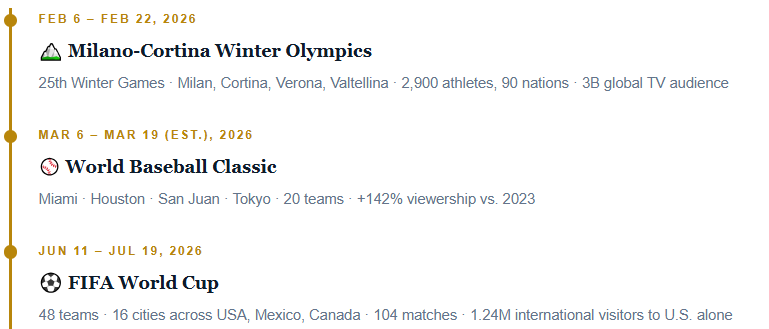
| ⚽ FIFA World Cup 2026 | Jun 11 – Jul 19 | USA / Mexico / Canada | $40.9B GDP (FIFA/OE); $5B+ short-term (BCG) | 1.24M intl. visitors (US cities alone) | ~5 billion |
| 🏔️ Milano-Cortina 2026 | Feb 6 – Feb 22 | Northern Italy | €5.3B total (Banca Ifis); €3B infrastructure legacy | 2–2.5M spectators | ~3 billion |
| ⚾ WBC 2026 | Mar 2026 | USA / Japan / Puerto Rico | High per-market ROI; $100M+ in media rights (est.) | ~800K total attendance (est.) | 200M+ (key markets) |
FIFA World Cup 2026: The Undisputed Financial Giant
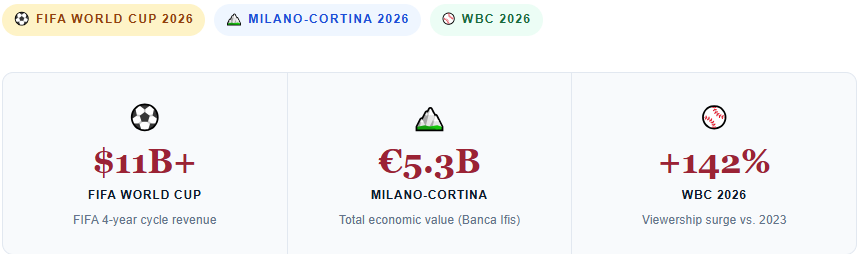
The 2026 World Cup is simply the largest peacetime economic event North America has ever hosted. FIFA and the WTO project the tournament could drive up to $40.9 billion in GDP across host countries and underpin the creation of nearly 824,000 full-time equivalent jobs. FIFA’s official 2023–2026 cycle budget projects $11 billion in total revenue — a 71% increase over the previous cycle — with broadcasting rights alone accounting for $4.26 billion, reflecting the value of North American prime-time coverage.
The hospitality sector is primed for extraordinary gains. Hotel room revenues in North American host markets are expected to rise between 7% and 25% in June 2026, with the most pronounced increases occurring on match days. History suggests later rounds supercharge costs dramatically: in Germany in 2006, average daily rates spiked 46.9% for the final match alone.
Milano-Cortina 2026: The Efficient, Legacy-Focused Games
Unlike previous editions that relied on massive new construction, the Milano-Cortina Winter Olympics will unfold across a dispersed footprint spanning Milan, Cortina d’Ampezzo, Verona, Valtellina, and Val di Fiemme — blending Italy’s fashion, culture, and Alpine tourism into a multi-destination showcase. With 3,500 athletes from 90 nations competing, the Games are forecast to generate €5.3 billion in total economic value, including €1.1 billion in immediate spending, €1.2 billion in tourism flows in the 12–18 months following, and €3 billion in long-term infrastructure legacy value.
💡 The Milano Model
Over 90% of Milano-Cortina venues are existing or temporary facilities — making this one of the most cost-efficient Winter Games in decades. The result: economic benefits flow to tourism and hospitality rather than being absorbed by construction debt, as happened in Turin 2006 and Sochi 2014.
WBC 2026: The Underdog Economy
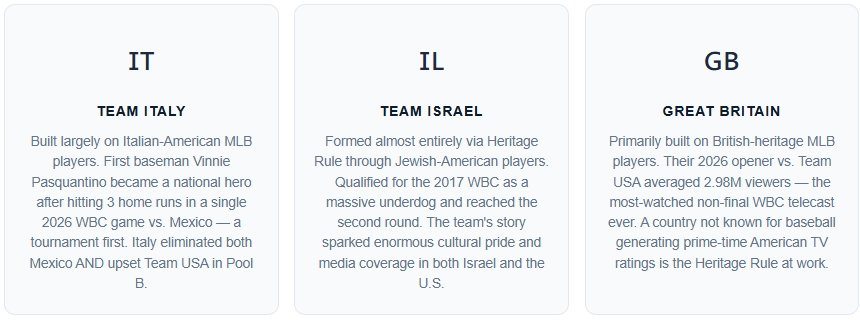
The 2026 World Baseball Classic is already drawing record attention. Average viewership across FOX, FS1, and FS2 is up 142% compared to the 2023 WBC through the tournament’s opening weekend. The USA vs. Great Britain matchup averaged 2.98 million viewers, peaking at 3.74 million — the most-watched non-final WBC telecast ever.
In economic terms, the WBC punches far above its weight in three specific markets: the United States, Japan, and South Korea. In Japan, nearly 100 million people watched the 2023 WBC, with 55+ million tuning in for the final as Shohei Ohtani struck out Mike Trout. The 2026 edition — now exclusively on Netflix in Japan — marks the tournament’s first major streaming-era test, with massive implications for subscription growth and global sports media rights valuation.
The WBC Paradox: Why Baseball’s “Heritage Rule” Is Its Most Underrated Asset
The WBC reaches fewer countries than the World Cup. Its prize money is modest by comparison. Yet for sheer emotional intensity and per-market cultural impact, few sporting events in the world can match it. A large part of the reason is a rule that barely gets discussed outside baseball circles: the Heritage Rule.
The Heritage Rule doesn’t just expand who can play for a country. It turns every MLB roster into a potential source of national heroes for nations that would otherwise never field a competitive team.
What Is the Heritage Rule?
Under WBC eligibility regulations, a player may represent a nation if they meet any one of the following criteria:
- They are a citizen of that country (hold a valid passport)
- They are a permanent legal resident of that country
- They were born in that country
- They have at least one parent who is/was a citizen of that country
- They have at least one parent who was born in that country
- They have at least one grandparent who was born in that country
That last three criteria — the Heritage provisions — are what make the WBC extraordinary. They allow American-born players of Italian, Israeli, Dutch, British, or German descent to represent those countries, dramatically raising the competitive quality of teams that would otherwise struggle to field MLB-caliber rosters.
🌍 Why This Matters Beyond Baseball
The Heritage Rule is a blueprint for growing a niche sport globally without diluting it. By connecting diaspora communities to their ancestral nations through elite competition, the WBC creates emotional storylines — a Jewish-American pitcher representing Israel, an Italian-American slugger playing in front of weeping nonnas — that transcend sport and become cultural events. For brands and broadcasters, these storylines are gold.
Investment Insight: Where the 2026 Sports Supercycle Creates Opportunity
For investors, the 2026 Sports Supercycle is not just a cultural moment. It is a identifiable demand surge concentrated in specific sectors across a known timeframe. Here’s where the money flows.
🏨 Hospitality & Travel
The Most Direct Play
Hotel occupancy and room rates in 16 World Cup host cities are projected to rise 7–25% in June 2026. Airbnb hosts in U.S. host cities alone are projected to earn $2.6B+ in combined revenue. Airlines serving Milan, Cortina, and Tokyo face capacity crunches through February and March. OTAs, hotel chains, and short-term rental platforms are the clearest direct beneficiaries.
📡 Media & Streaming
The Streaming Rights War
Netflix’s exclusive deal for WBC Japan broadcasts marks a landmark moment: the first time Samurai Japan games won’t air on free-to-air Japanese TV. Combined with FOX Sports’ record WBC viewership (+142%) and the World Cup’s $4.26B in broadcast rights, 2026 is a watershed year for sports streaming economics. Platforms with live sports rights are structurally advantaged.
🎰 Sports Betting
The Legalization Multiplier
With sports betting now legal in 38+ U.S. states, the 2026 World Cup will be the first held in North America in the legal betting era. Three simultaneous global tournaments across spring and summer create an unprecedented volume of betting markets. Gaming operators with strong mobile platforms and North American licenses are positioned for peak engagement periods.
🏗️ Infrastructure & Cities
The Long-Tail Dividend
Milan’s metro upgrades (€55M), Northern Italy’s alpine rail connections (€416M), and $2B+ in U.S. stadium improvements create legacy infrastructure that generates tourism returns for years. The 1994 World Cup helped establish MLS in the U.S. — a similar catalytic effect on soccer infrastructure, youth participation, and stadium development is widely projected for 2026.
| Sector | Key Catalyst Event | Opportunity Window | Conviction |
|---|---|---|---|
| Hotels & Short-Term Rentals | World Cup (16 U.S. cities) | May – July 2026 | High |
| Airlines (transatlantic, Pacific) | Winter Olympics + WBC (Japan) | Jan – Mar 2026 | High |
| Streaming Platforms (sports rights) | WBC Netflix Japan; World Cup broadcast deals | Full year 2026 | High |
| Sports Betting Operators | World Cup (first in legal U.S. era) | Jun – Jul 2026 | Medium-High |
| Sportswear & Equipment | All three events; kit sales surge | Q1 – Q3 2026 | Medium |
| Italian Tourism Infrastructure | Milano-Cortina legacy investments | 2026 – 2028 | Medium |
| Stadium Construction / AV Tech | World Cup venue upgrades | Already underway | Priced In |
⚡ The Bottom Line
2026 is a one-of-a-kind year in the global sports economy. Three mega-events across three continents create a synchronized surge in tourism, media consumption, and consumer spending that no single year in recent memory can match. Here’s what to take away:
- The World Cup is the economic juggernaut — $40.9B in projected GDP impact, 1.24M international visitors to the U.S., and the first North American hosting since 1994 in the era of legal sports betting and streaming.
- Milano-Cortina is the smart money play — €5.3B in value with minimal construction debt, legacy infrastructure that pays dividends for a decade, and a 160% surge in foreign arrivals already confirmed.
- The WBC is the highest-engagement, lowest-cost event — +142% viewership growth, a Netflix streaming landmark in Japan, and the Heritage Rule creating national story lines that generate media attention no marketing budget could buy.
- For investors: hospitality, streaming platforms with live sports rights, and U.S. sports betting operators are the clearest plays. Tourism infrastructure in Northern Italy offers a longer-duration return.
- The deeper story: The Heritage Rule is a quiet revolution in how sports builds global audiences. It’s a model that every governing body in every sport should study — and that brands, broadcasters, and investors should price into their long-term sports economy thesis.
Disclaimer: This article is for informational and educational purposes only. Nothing herein constitutes investment advice or a solicitation to buy or sell any security. All economic projections cited are third-party estimates and subject to change. Always conduct your own research and consult a qualified financial advisor before making investment decisions.