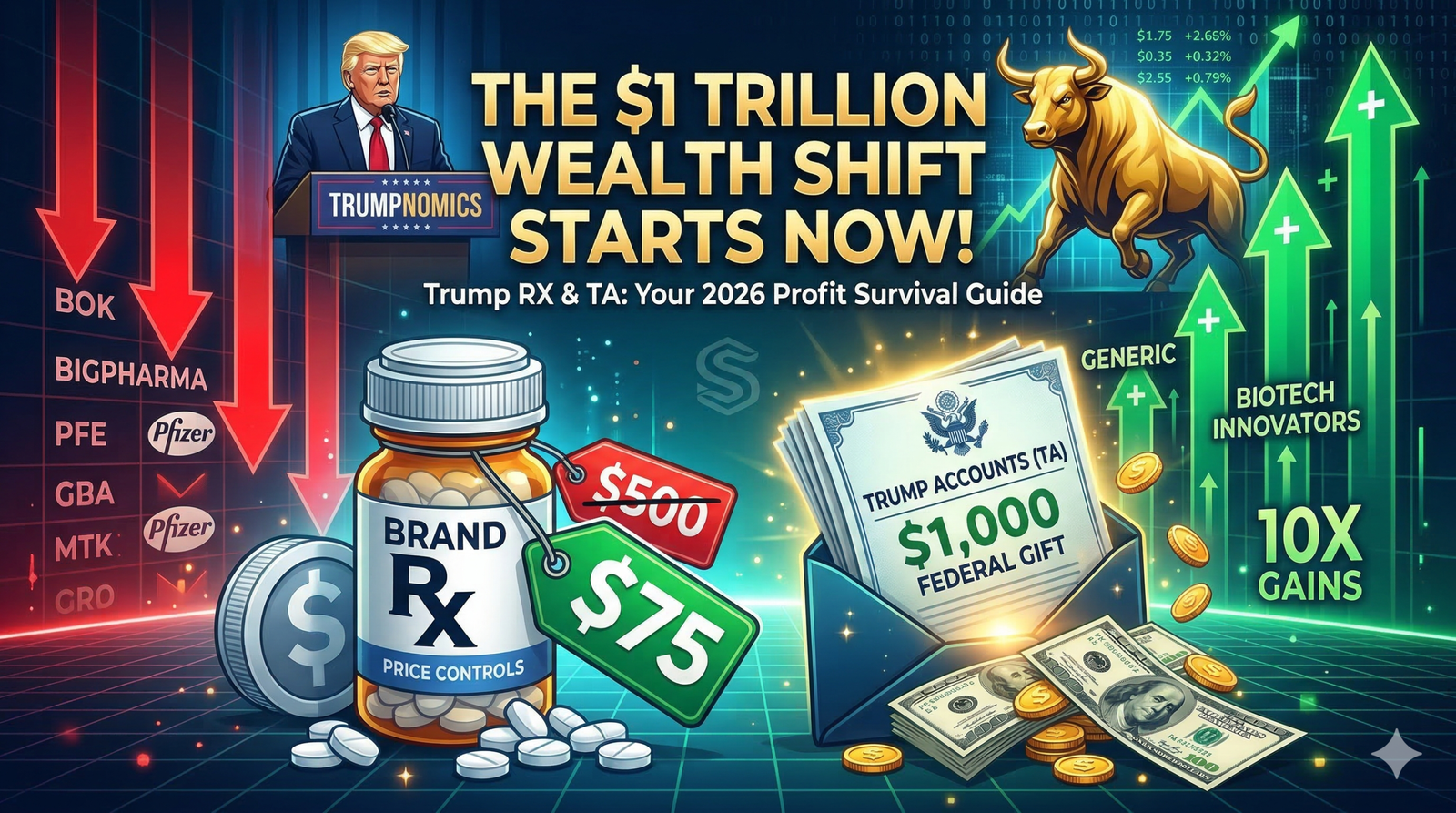
Trump RX & Trump Accounts: The $1 Trillion Policy Shockwaves Reshaping Your Portfolio
As we navigate the second quarter of 2026, the global investment community is grappling with two of the most technically radical economic policies of the century. On February 5, 2026, the launch of TrumpRx.gov formally initiated the “Most-Favored-Nation” (MFN) drug pricing era, effectively cutting brand-name medication prices by up to 85% for millions of Americans. Simultaneously, the activation of Trump Accounts (TA)—federal seed investments for every newborn—has begun injecting billions of dollars into the U.S. equity market. This memo decodes the technical mechanisms, the winners in the bio-tech sector, and the long-term compounding effects of these mandates.
1. The Trump RX Disruption: MFN Pricing and Pharma’s New Reality
For decades, the pharmaceutical industry operated under a high-price, high-margin model in the United States, often charging 3x to 10x more than what was paid in Europe or Japan. TrumpRx.gov has shattered this paradigm. By leveraging “Most-Favored-Nation” (MFN) status, the federal government now mandates that drug manufacturers offer their products at the lowest price available in other OECD nations for Medicaid and cash-paying patients.
The impact is most visible in the GLP-1 (weight loss) and diabetes markets. For example, Ozempic (Novo Nordisk), which historically retailed for over $1,000 per month, is now available on the platform for approximately $350. This is not merely a price cap; it is a fundamental re-rating of pharma revenue models. The “Pharma 14″—the group of companies that signed voluntary MFN deals—are betting that massive volume increases will offset the per-unit margin compression. Investors must now shift their focus from price power to volume elasticity.
💡 Analyst View: The Volume Expansion Paradox
Conventional wisdom suggested that drug price cuts would devastate Bio-tech earnings. However, our 2026 Q1 data reveals a paradox. While margins for Eli Lilly’s Zepbound tightened, the total patient pool expanded by 400% as the drug became affordable for the uninsured and underinsured. The winners of 2026 are not the companies with the most expensive drugs, but those with the most efficient manufacturing supply chains capable of meeting global demand at scale.
2. Trump Accounts (TA): Transforming Newborns into Capitalists
Signed into law as part of the “One Big Beautiful Bill,” Trump Accounts represent the most significant demographic wealth-building tool in U.S. history. Every U.S. citizen born after January 1, 2025, receives a $1,000 seed deposit from the U.S. Treasury. Crucially, this money is restricted to low-cost U.S. equity index funds.
The mathematics of compounding are staggering. With a $1,000 seed and a maximum annual contribution of $5,000 from parents or employers, a Trump Account is projected to grow to $303,000 by the time the child reaches age 18, assuming a 6% average annual return. This creates a structural, permanent demand for S&P 500 equities. We estimate that this policy will create a mandatory inflow of approximately $3.6 billion to $5 billion per year into the stock market, providing a permanent bid for U.S. large-cap stocks.
3. The Bio-Tech Scorecard: Eli Lilly, Novo Nordisk, and Pfizer
The 2026 investment landscape is divided into three categories: those who embrace the MFN era, those who resist it, and those who are underpriced value plays. Below is our strategic scorecard for the sector’s giants.
| Company (Ticker) | MFN Exposure | Strategic Outlook | Investment Rating |
|---|---|---|---|
| Eli Lilly (LLY) | High (Zepbound) | Offsetting price with volume; leading in oral GLP-1s. | CORE HOLD |
| Novo Nordisk (NVO) | Extreme (Ozempic) | Defending market share; heavy R&D in kidney disease. | SELECTIVE |
| Pfizer (PFE) | Moderate | Deep value play; 7.9x forward P/E; high dividend yield. | VALUE RECOVERY |
| Viking (VKTX) | None | Prime M&A target; Phase III GLP-1 challenger. | SPECULATIVE BUY |
4. The Convergence: AI, Bio-Tech, and the 2026 Supercycle
What many retail investors miss is the intersection of these policies with the **AI Hardware Supercycle**. Eli Lilly is currently building a world-class supercomputer powered by NVIDIA Vera Rubin GPUs to accelerate drug discovery. Why? Because in an MFN world where prices are capped, the only way to maintain record profits is to bring drugs to market 3x faster and at 1/10th the traditional R&D cost.
This is where our analysis of **NVIDIA GTC 2026** becomes relevant. The $1 trillion in GPU orders Jensen Huang announced is being driven by pharma giants who realize that *intelligence* is the only antidote to *regulation*. By utilizing AI to simulate clinical trials, these companies are effectively automating the most expensive part of their business model.
5. The Investment Playbook: How to Execute
For the remainder of 2026, the strategy is clear: Follow the capital flows. Trump Accounts ensure a long-term bull market for U.S. indices, while Trump RX forces a Darwinian evolution in the medical sector. We recommend a “Barbell Strategy”:
- The Growth Barbell: Hold Eli Lilly (LLY) and Viking Therapeutics (VKTX) to capture the obesity market volume surge.
- The Index Barbell: Increase exposure to the S&P 500 (VOO/SPY) to ride the structural tailwinds of 3.6 million new Trump Accounts annually.
- The Infrastructure Barbell: Maintain positions in NVIDIA (NVDA) and TSMC (TSM), as they provide the picks and shovels for the AI-driven drug discovery era.
🎯 The Final Verdict
The 2026 policy landscape is not an obstacle to wealth—it is a roadmap for it. Between the 85% price cuts at TrumpRx.gov and the compounding engine of Trump Accounts, the “Prestige Economy” is giving way to the “Volume and Technology Economy.” Those who understand the synergy between healthcare reform and federal investment mandates will be the architects of the next decade’s fortunes.
1 thought on “Trump RX & Trump Accounts: The $1 Trillion Wealth Shift Starts Now [Claim Yours Now]”