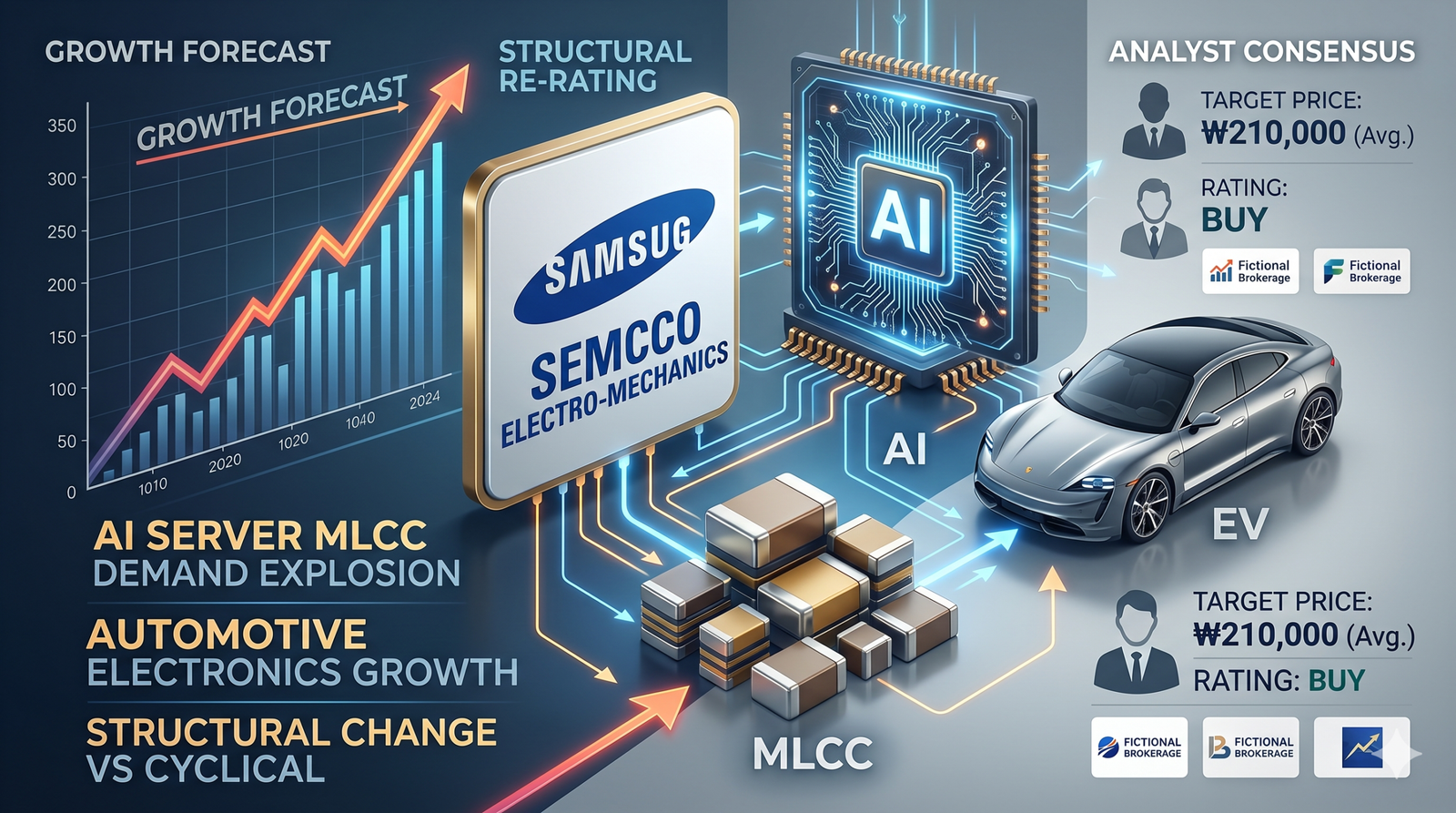
KRX: 009150 | Current Price: KRW 682,500 (All-time High) | Published: April 2026 | For informational purposes only. Not investment advice.
⚠️ Valuation Context — Read Before Proceeding
SEMCO shares are trading at an all-time high of KRW 682,500 following eight consecutive sessions of gains (as of April 17, 2026). The structural thesis for this company is compelling — but the pace and magnitude of the recent rally means that a meaningful portion of the positive scenario is already reflected in the price. Investors approaching this stock for the first time at current levels must weigh the quality of the underlying business against the valuation premium they are being asked to pay. This report addresses both dimensions with equal weight.
Introduction: When Passive Components Become Active Growth Drivers
For most of the past decade, Samsung Electro-Mechanics occupied a quiet corner of the Korean equity market — valued largely as a cyclical supplier of multilayer ceramic capacitors (MLCCs) to the smartphone industry. That narrative is undergoing a fundamental revision. The build-out of global AI infrastructure has elevated SEMCO from a commoditized component maker into a mission-critical supplier sitting at the intersection of three of the most durable technology trends of this decade: artificial intelligence, electric vehicles, and advanced semiconductor packaging.
The company’s record-breaking 2024 revenue of KRW 10.29 trillion — its first time crossing the ten-trillion-won threshold — was driven not by smartphone unit growth, but by a decisive shift toward higher-specification, higher-margin products. In 2025 that momentum accelerated, with Q4 2025 revenue rising 16% YoY and operating profit surging 108% YoY. The structural case is real. The valuation debate, however, is now equally important.
The AI MLCC Premium: Price Upgrade, Not Just Volume Growth
The conventional MLCC growth narrative centers on unit shipments. The AI server era breaks that model — and in SEMCO’s favor. Estimates from SK Securities indicate that a single AI server requires approximately eight times more MLCCs than a conventional server. Some industry estimates place the per-unit count at up to 25,000 MLCCs per AI server, compared with roughly 2,000 for a standard unit. But the more important variable is not count — it is specification and price.
AI servers operate at higher thermal loads, tighter voltage tolerances, and greater power density than any prior commercial application. This demands MLCCs with elevated capacitance, superior dielectric stability across temperature ranges, and tighter dimensional tolerances — components that command ASPs several multiples above standard smartphone-grade variants. A key 2026 development reinforces this view: Taiyo Yuden announced price hikes on major product lines effective May 2026, with Murata implementing increases from April. SEMCO, whose MLCC utilization already reached 98% in Q3 2025, stands to be a direct beneficiary of this industry-wide repricing. Analysts at Hana Securities describe SEMCO as having entered the MLCC price hike supercycle — a structural, multi-year repricing of high-specification components, not a temporary inventory-driven blip.
Core Thesis
The AI server MLCC story is a unit-price (P) upgrade, not merely a shipment volume (Q) expansion. Even modest AI infrastructure growth translates into outsized revenue contribution from this segment. Korean domestic brokerage consensus now projects 2026 blended MLCC ASP growth of approximately 20% YoY, with further upside if the price hike cycle extends into 2027 as expected.
Financial Performance & 2026 Forecast
SEMCO closed 2024 with record revenue of KRW 10.29 trillion (+15.8% YoY) and operating profit of KRW 735 billion (+11.3%). Momentum accelerated sharply in 2025: Q1 2025 operating profit jumped 74% QoQ; Q4 2025 delivered a 108% YoY OP surge. For full-year 2026, Korea Investment & Securities estimates revenue of KRW 13.4 trillion (+18.5% YoY) and operating profit of KRW 1.48 trillion (+61.6% YoY), implying a meaningful step-change in profitability.
| Fiscal Year | Revenue (KRW bn) | YoY Growth | Operating Profit (KRW bn) | OP Margin |
|---|---|---|---|---|
| FY 2023 | 8,888 | Baseline | 660 | 7.4% |
| FY 2024 (A) | 10,290 | +15.8% | 735 | 7.1% |
| FY 2025 (A) | ~11,500 | ~+12% | ~1,050 | ~9.1% |
| FY 2026 (E) | ~13,405 | +18.5% | ~1,476 | ~11.0% |
| Sources: Samsung Electro-Mechanics official earnings releases (FY2023–2025). FY2026E: Korea Investment & Securities (April 2026). All figures approximate. (A) = Actual; (E) = Estimate. | ||||
Strategic Analysis: Three Pillars of Structural Growth
1. AI Server MLCCs — Supercycle in Its Early Innings
AI server MLCCs occupy a category of their own. Higher operating temperatures, tighter voltage tolerances, and the growing adoption of 800V HVDC-based power infrastructure from 2027 onward will drive demand for high-voltage, high-capacitance MLCCs that very few manufacturers can supply at volume. SEMCO is one of a handful of companies globally with the process technology and quality certification to serve this market at scale. With MLCC utilization already at 98% and competitor Taiyo Yuden publicly initiating price hikes for May 2026, the pricing inflection point has arrived.
2. Automotive MLCCs & FC-BGA — The Second & Third Engines
Automotive MLCCs now account for approximately 15% of total MLCC revenue and are tracking toward 25% by year-end 2025, supported by a large supply agreement with BYD and continued ADAS adoption. Meanwhile, FC-BGA substrates for AI accelerators — including confirmed supply relationships for Nvidia’s supply chain and Tesla AI chips — are entering what analysts at Hana Securities describe as a structural shortage phase beginning in H2 2026. The dual bottleneck in MLCC and FC-BGA supply simultaneously is an unusual configuration that strongly supports margin expansion.
3. Glass Substrates — Long-Term Optionality, Now with Customer Proof Points
In early April 2026, SEMCO was confirmed to have supplied glass substrate samples to both Apple and Broadcom, following its Sejong pilot line ramp. Glass substrates replace organic cores in FC-BGA packages with glass, enabling finer circuit patterns, lower warpage, and superior thermal stability for next-generation AI accelerator packaging. A joint venture MOU with Sumitomo Chemical is in place for glass core production. Mass production is targeted for 2027. Samsung Group’s unique position — combining chip design (Samsung Electronics), glass interposers (Samsung Display), and glass core substrates (SEMCO) — constitutes the only fully vertically integrated glass substrate ecosystem globally.
⚡ Glass Substrate — April 2026 Milestone
Sample deliveries to Apple and Broadcom mark SEMCO’s transition from glass substrate developer to verified supplier to two of the world’s most demanding customers. Customer relationships built through the existing FC-BGA business provide the commercial channel for adoption. However, glass substrate revenues remain pre-commercial and should be treated as optionality rather than near-term earnings support.
Analyst Consensus & Target Prices — Rapidly Moving Goalposts
Analyst target prices have been revised upward at an unusually rapid pace in 2026, reflecting the MLCC price hike catalyst and the FC-BGA shortage thesis. The table below captures the most current published targets as of April 2026 and highlights the wide dispersion between the most bullish and most conservative views — itself a signal of elevated uncertainty at current price levels.
| Institution | Rating | Target Price (KRW) | vs. Current (682,500) | Report Date |
|---|---|---|---|---|
| Hana Securities | BUY | 810,000 | +18.7% | Apr 16, 2026 |
| Meritz Securities | BUY | 700,000 | +2.6% | Apr 2026 |
| KB Securities | BUY | 550,000 | −19.4% | Mar 18, 2026 |
| Korea Investment & Securities | BUY | 570,000 | −16.5% | Apr 2026 |
| Sources: Hana Securities (Apr 16, 2026), Meritz Securities, KB Securities (Mar 18, 2026), Korea Investment & Securities. Note: KB and Korea Investment targets may not yet reflect the most recent April 2026 MLCC catalyst. Target prices are 12-month forward estimates. | ||||
Valuation Analysis: Is KRW 682,500 Justified — Or Is Premium Risk Accumulating?
This is the central question facing investors in SEMCO today. The structural thesis is intact and arguably strengthening. But the stock has delivered a multi-hundred-percent return from its 52-week low of KRW 116,200, and now sits at an all-time high. The following metrics provide context for whether current levels are sustainable.
Hana Securities’ KRW 810,000 target — the most aggressive current published estimate — is derived from a 2027E EPS of KRW 22,874 multiplied by a peer-based P/E of 35.4x, drawn from global FC-BGA comparables Ibiden and Unimicron. At the current price of KRW 682,500, this implies an approximate 2027 forward P/E of ~29.8x. On the 2026 consensus OP estimate of approximately KRW 1.48 trillion, assuming a net profit ratio consistent with recent quarters, the implied 2026 forward P/E is approximately 35–40x. For a Korean industrial components company — even one undergoing a structural re-rating — this is at the upper bound of historical precedent.
By comparison, KB Securities’ March 2026 target of KRW 550,000 was derived using a forward P/E of 36.1x and P/B of 4.27x at a price level significantly below current trading. At KRW 682,500, those same multiples would imply the stock is trading approximately 24% above fair value on KB’s model — a meaningful premium that has not yet been closed by an updated target revision.
🔴 Premium Risk — Key Considerations at Current Levels
- Analyst dispersion is wide. The spread between the highest (KRW 810,000) and lowest current target (KRW 570,000) is 42%. This level of disagreement reflects genuine uncertainty about the magnitude and durability of the MLCC price hike cycle — not merely timing differences.
- The stock has already priced in much of the good news. Eight consecutive sessions of gains to an all-time high, driven by the Hana Securities target upgrade and MLCC price hike news, means the market has acted swiftly. Investors entering now are not discovering an overlooked opportunity — they are paying for a well-understood thesis.
- Forward multiples are at the high end of historical range. At approximately 35–40x 2026E earnings, SEMCO is being valued in line with high-growth global semiconductor equipment names. This multiple is only justified if the MLCC supercycle and FC-BGA shortage persist through 2027 and beyond as the most bullish analysts project.
- Execution risk on glass substrates. The glass substrate business — which is partly responsible for the re-rating — has not yet generated revenue at scale. Any delay in customer qualification or mass production ramp beyond 2027 would remove a key pillar of the long-term bull case.
Additional Risk Factors
- AI Capex Deceleration: A slowdown in hyperscaler infrastructure spending would simultaneously reduce demand for AI server MLCCs and FC-BGAs. Global tariff uncertainty and macroeconomic headwinds could accelerate such a deceleration.
- Chinese MLCC Competition: Chinese manufacturers have grown their global MLCC share to approximately 10%. While they remain concentrated in lower-grade products, continued technology advancement could compress SEMCO’s mid-tier pricing power over a multi-year horizon.
- IT Demand Weakness: KB Securities notes that PC and mid-range smartphone demand is softening due to elevated memory prices. While AI and automotive demand provides a substantial offset, weakness in legacy IT applications could disappoint revenue expectations for the optical solutions segment.
- Samsung Electronics Correlation: With Samsung Electronics as the controlling shareholder and a major customer, SEMCO’s fortunes remain partially correlated with its parent’s semiconductor cycle and strategic direction.
Investment Verdict — Key Takeaways
Summary for Long-Term Investors
- The structural thesis is real and strengthening. The MLCC price hike supercycle, FC-BGA structural shortage, and glass substrate optionality collectively represent a fundamental improvement in SEMCO’s earnings quality and growth trajectory. These are not cyclical tailwinds — they are structural upgrades to the company’s product mix and pricing architecture.
- But the price already reflects much of this. At KRW 682,500 — an all-time high — the stock trades at 35–40x 2026E earnings and above several brokerages’ current 12-month target prices. The risk-reward ratio at this specific entry point is materially less favorable than it was six or twelve months ago.
- Analyst dispersion is wide. The range of current targets spans KRW 570,000 to KRW 810,000 — a 42% spread. Only the most bullish scenario (full supercycle plus glass substrate revenue surprise) justifies current levels in the near term. The base case implies modest downside from present prices on a 12-month view, absent further positive catalysts.
- For existing holders: the bull case remains intact if MLCC price hikes are sustained and FC-BGA shortages deepen as projected. For new entrants at current levels: position sizing and entry timing deserve careful consideration. A pullback toward the KRW 550,000–600,000 range would materially improve the risk-reward profile without altering the long-term thesis.