The Case for Nuclear: Two Crises, One Solution
A Geopolitical Catalyst
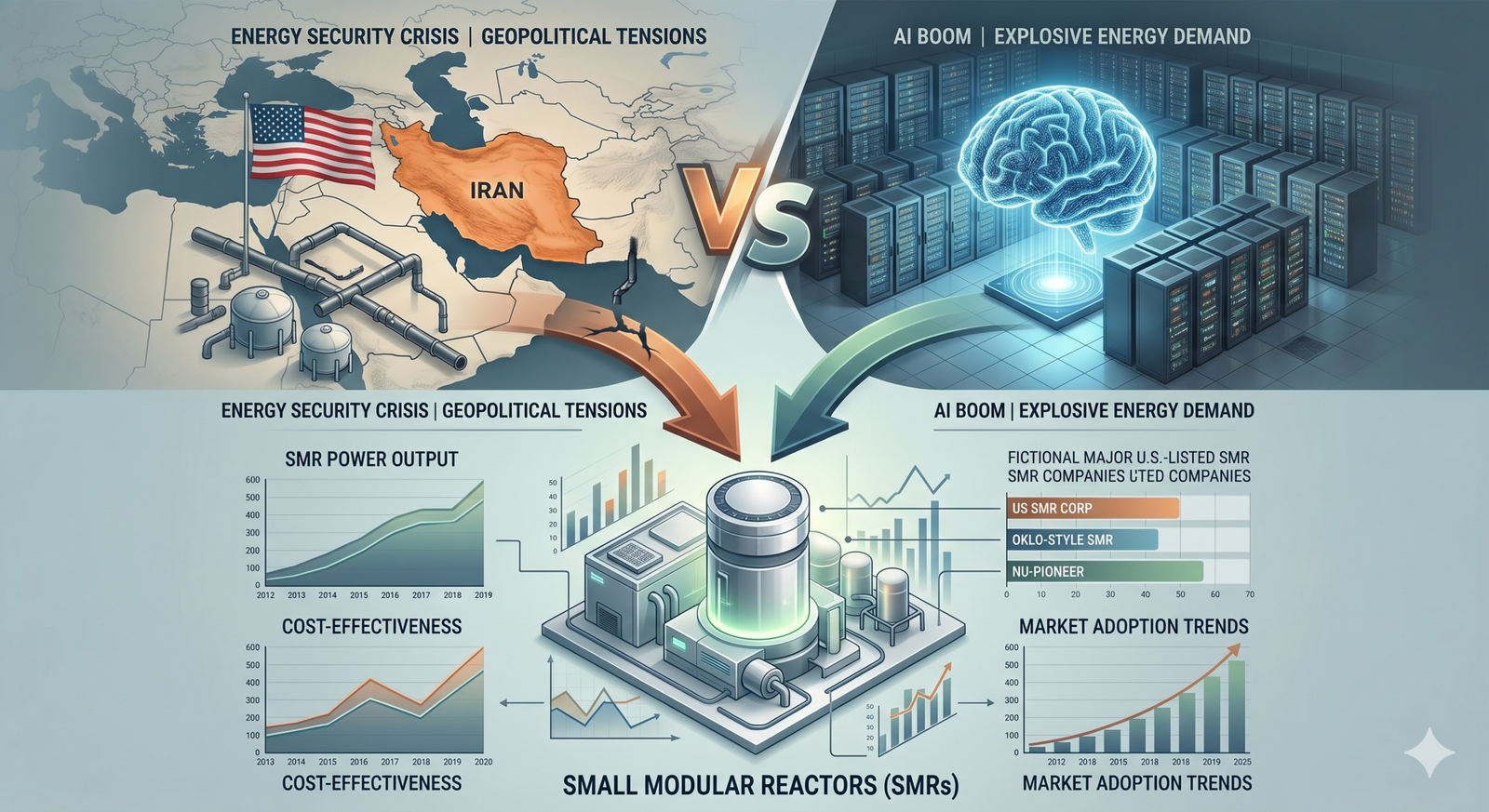
Escalating tensions between the United States and Iran have delivered a familiar warning to energy markets: the global economy remains dangerously exposed to Middle Eastern oil supply disruptions. Every crisis in the Strait of Hormuz is a reminder that fossil fuel dependence is not only a climate liability — it is a national security vulnerability. The case for domestic, always-on energy has never been more urgent.
The AI Power Problem
At the same time, a second crisis is forming in Silicon Valley. Microsoft, Google, Meta, and Amazon are racing to build ever-larger data centers to train and run next-generation AI models. These facilities operate around the clock, every day of the year, consuming enormous quantities of electricity. Solar and wind cannot meet this need — their intermittency is a structural mismatch with the demand for continuous, reliable power. What the industry requires is firm, carbon-free baseload electricity, and it needs it at scale.
Small Modular Reactors — compact, factory-built nuclear plants — sit precisely at the intersection of both problems. They offer 24/7, zero-carbon power that can be sited close to industrial facilities and data campuses without the footprint of a traditional gigawatt-scale nuclear plant. For investors, this convergence has created a potentially historic opportunity in a small group of publicly listed companies.
What Makes Small Modular Reactors Different
A conventional nuclear plant takes 15 years to build, produces over 1,000 megawatts, and requires a massive permanent site. An SMR, by contrast, generates between 1 and 300 megawatts per unit, is manufactured in a factory, and can be shipped and assembled on-site in a fraction of the time. Multiple units can be added incrementally as demand grows — a flexibility that traditional nuclear cannot offer.
Crucially, SMRs produce no carbon emissions during operation and provide power continuously regardless of weather conditions. For technology companies with legally binding net-zero commitments and AI workloads that cannot tolerate power interruptions, these characteristics are not merely attractive — they are increasingly necessary. The result is a wave of long-term power purchase agreements between hyperscalers and nuclear developers that is validating the entire sector.
The Four Companies to Know
The US-listed SMR and advanced nuclear universe is still small, but four companies have emerged as the primary vehicles for investors seeking exposure to this theme. They differ significantly in their technology approach, revenue maturity, regulatory status, and risk profile — and understanding those differences is essential before allocating capital to any of them.
| Company | Ticker | Technology | Revenue Status | NRC Approval | Risk Profile |
|---|---|---|---|---|---|
| NuScale Power | SMR | Light-water SMR, 77 MWe per module | Early (~$8M/qtr) | Approved | Medium–High |
| Oklo Inc. | OKLO | Fast-fission microreactor, fuel recycling | Pre-revenue | Pending | High |
| Centrus Energy | LEU | HALEU enrichment and fuel supply | $74.9M Q3 2025 | N/A (fuel supplier) | Medium |
| NANO Nuclear | NNE | KRONOS portable gas-cooled microreactor | Pre-revenue | Pending | Very High |
Source: NRC, SEC filings, company investor relations. Data as of April 2026.
Company Analysis
NuScale Power (NYSE: SMR) — The Regulatory Pioneer
NuScale occupies a position that no other US company can claim: it holds the only Nuclear Regulatory Commission-approved small modular reactor design in the country. That approval, covering its uprated 77 MWe light-water reactor, came after more than a decade of regulatory engagement and represents a durable competitive moat. In a market where the path from concept to commercial operation runs entirely through the NRC, this milestone matters enormously.
Its commercial pipeline reflects that credibility. A landmark agreement with the Tennessee Valley Authority targets up to six gigawatts of SMR capacity across seven states — an arrangement that, if executed, would make NuScale the backbone of US clean baseload power for decades. A separate project in Romania, where NuScale serves as a subcontractor to Fluor, reached its final investment decision, providing an international proof of concept.
The challenge is timing. Revenue today consists almost entirely of front-end engineering and design studies — roughly $8 million per quarter. First reactors are not expected to come online until the early 2030s, and the company is burning cash at a significant rate in the interim. NuScale is a genuine long-duration investment that demands patience and tolerance for dilution risk.
Oklo Inc. (NYSE: OKLO) — The AI Industry’s Bet on Nuclear
No company in the nuclear sector has attracted as much speculative attention as Oklo. Its stock reached an all-time high of $193 in October 2025, fueled by a unique combination of revolutionary technology, influential backing, and a landmark partnership with one of the world’s largest technology companies.
Oklo’s Aurora reactor uses a liquid-metal-cooled, fast-fission design fueled by metallic uranium — a denser fuel that can be recycled in a closed loop, enabling roughly a decade of continuous operation without refueling. For data center operators seeking to minimize both downtime and logistical complexity, this is a compelling proposition. The company’s partnership with Meta Platforms, and the presence of OpenAI CEO Sam Altman on its board, provide both commercial validation and the kind of institutional credibility that most pre-revenue companies cannot generate.
The risk is equally significant. Oklo has generated no revenue, holds no NRC approval, and does not expect its first deployment before 2027. Its valuation reflects extraordinary optimism about a future that remains uncertain. The saving grace is a balance sheet holding over $1 billion in cash and marketable securities, which provides a meaningful buffer against regulatory delays.
Centrus Energy (NYSE American: LEU) — The Fuel Behind the Reactors
While NuScale and Oklo compete for the reactor, Centrus Energy supplies the fuel that makes them run. It is the only company in the United States licensed to produce High-Assay Low-Enriched Uranium — the advanced fuel required by virtually every next-generation reactor design on the market, including Oklo’s. That position is not an accident; it reflects decades of technical expertise and an active partnership with the Department of Energy to restore domestic enrichment capacity at scale.
Critically, Centrus is already profitable. It reported $74.9 million in revenue and $3.9 million in net income for the third quarter of 2025 — figures that make it structurally different from every other company in this comparison. Its investment case rests on a straightforward logic: whichever reactor design ultimately wins the commercial race, it will need fuel, and Centrus holds the only domestic license to provide it. This gives the company a degree of market-agnosticism that is rare in a sector built on competing bets.
NANO Nuclear Energy (Nasdaq: NNE) — The Defense Sector Wildcard
NANO Nuclear targets a niche that none of its larger peers are pursuing at scale: portable, rapidly deployable microreactors for defense and remote-power applications. Its KRONOS reactor is a high-temperature gas-cooled design built for rapid transport and field deployment — think forward military bases, disaster relief operations, and off-grid industrial sites far from the national grid.
When the US Army announced a program to deploy small reactors to military installations in late 2025, the reaction across the sector was immediate: NuScale surged 16%, Centrus jumped 10%. NANO is positioned to benefit from exactly this kind of government mandate, but it remains the most speculative name in the group — pre-revenue, pre-approval, and years from any commercial deployment. It is a position suited only to investors who can absorb a complete loss of capital.
Risk vs. Upside Potential at a Glance
The chart below provides an editorial scoring of each company across two dimensions. Risk reflects regulatory, revenue, and execution uncertainty. Upside reflects potential return if commercial deployment proceeds as planned. Scores are illustrative, not quantitative forecasts.
NuScale Power (SMR)
Oklo Inc. (OKLO)
Centrus Energy (LEU) — Best Risk-Adjusted
NANO Nuclear Energy (NNE)
Editorial scoring only. Not a forecast or financial recommendation.
Key Takeaways
- NuScale (SMR) holds the only NRC-approved US SMR design and the strongest utility pipeline — but revenue and deployment remain years away, requiring sustained patience.
- Oklo (OKLO) is the highest-profile AI-nuclear play, backed by Sam Altman and Meta, with a $1 billion-plus balance sheet — but it carries commensurate risk as a pre-revenue, pre-approval company.
- Centrus Energy (LEU) is the strongest risk-adjusted position in the group: profitable today, the sole US HALEU producer, and a structural beneficiary of every reactor deployment regardless of design.
- NANO Nuclear (NNE) targets a genuine defense niche with meaningful government tailwinds, but it remains a speculative early-stage position with no near-term commercial catalysts.
- No company on this list has deployed a commercial reactor. All carry meaningful execution, regulatory, and dilution risk. Position sizing and a long time horizon are essential.
Investment Outlook: The Atomic Age of AI
The AI–nuclear alliance is no longer a speculative thesis. Microsoft, Google, Meta, and Amazon have signed legally binding power purchase agreements with nuclear developers because no other energy source can meet their requirements. The geopolitical environment is reinforcing the same conclusion from a different direction: governments that depend on imported fossil fuels face a strategic liability, and domestic nuclear capacity addresses it directly.
What this means for investors is a sector with an unusually clear long-term demand signal — but one where the path from current development stage to commercial deployment is long, uncertain, and littered with regulatory and financing hurdles. The companies that survive that journey stand to benefit from one of the most durable structural trends in the energy market. Those that stumble will have cost their investors dearly.
Whether the right approach is the regulatory solidity of NuScale, the aggressive growth narrative of Oklo, the profitable stability of Centrus, or the asymmetric defense bet of NANO Nuclear will depend entirely on individual risk tolerance and time horizon. The underlying thesis, however, is the same across all four: the atomic age of AI is just beginning, and the demand for reliable, carbon-free nuclear power is not going away.