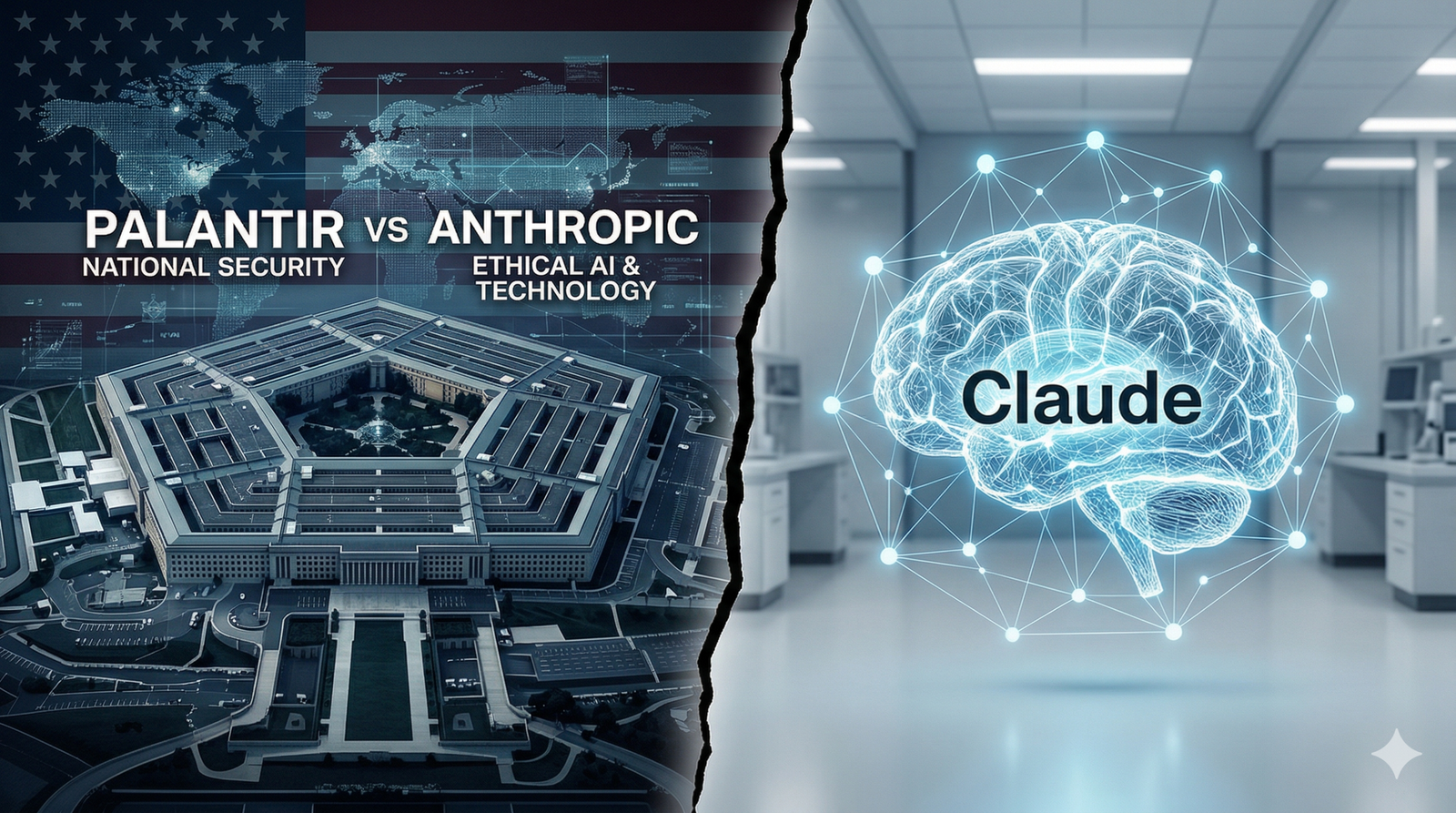
The Strategic Divergence: Palantir’s Geopolitical Moat vs. Anthropic’s Regulatory Risks in the Trump Era
The defense AI sector is undergoing a quiet but consequential restructuring — one driven not by algorithmic breakthroughs or chip architectures, but by the far older forces of political capital and sovereign alignment. For investors seeking durable alpha in artificial intelligence, the emerging divergence between Palantir Technologies and Anthropic offers a rare case study in how geopolitical positioning can redefine the competitive landscape more decisively than any product roadmap.
Strategic Snapshot: Palantir vs. Anthropic
| Metric | Palantir (PLTR) | Anthropic |
|---|---|---|
| Political Alignment (Trump Admin) | ● High | ● Low |
| DoD Integration Depth | ● Deep (20+ yrs) | ● Contested |
| Frontier Model Capability | ● Moderate | ● Best-in-Class |
| Regulatory / Supply Chain Risk | ● Low | ● Elevated |
| Public Sector Revenue Ceiling | ● Expanding | ● Structurally Capped |
| Valuation Risk (Near-Term) | ● High (P/S overhang) | ● Repricing Risk |
The Political Trigger: When a Post Becomes a Procurement Standard
When President Trump publicly designated Palantir a “patriotic asset” and a “model for American defense,” most market observers read it as rhetorical flourish. They were wrong. In the architecture of defense procurement, such public endorsements function as informal policy signals — a directional mandate that shapes how agency budget allocators, contracting officers, and program managers interpret vendor relationships. The statement did not merely praise a company; it effectively established a political standard of trustworthiness against which every other AI defense vendor will now be measured.
Palantir has spent over two decades engineering precisely this outcome. Its Gotham and Foundry platforms are so deeply embedded in intelligence workflows that extraction would be operationally catastrophic. What Trump’s endorsement accomplished was to formalize what insiders already understood: in this administration’s defense economy, political proximity is a procurement advantage, and Palantir has cultivated that proximity with the same deliberateness it applies to its software architecture.
Strategic Risk & Opportunity Scorecard
Analyst composite scores across four dimensions (0 = unfavorable, 100 = favorable for long-term investors)
Source: Analyst proprietary composite. Scores reflect qualitative and structural assessment, not quantitative financial modelling. For illustrative purposes only.
Anthropic’s Regulatory Exposure: Ethics as a Balance Sheet Liability
Anthropic’s reported refusal to fulfill certain Department of Defense integration requests carries significance that extends well beyond the immediate contractual dispute. From a purely ethical standpoint, the decision is defensible. From an investment standpoint, however, it is something considerably more troubling.
In an administration that has demonstrated a willingness to leverage regulatory instruments as competitive tools, declining a DoD request is not a neutral act. It creates the conditions for Anthropic to be categorized — formally or informally — as a “supply chain risk” within federal procurement frameworks. The compound effect is a structural ceiling on Anthropic’s public-sector addressable market at the precise moment that market is expanding most aggressively. This does not merely reduce near-term contract wins; it reprices the long-term growth narrative that justifies the company’s current valuation premium.
Analyst Risk Flag
A “supply chain risk” designation — once embedded in federal procurement frameworks — is asymmetric and durable. Agencies become reluctant to build critical workflows around a vendor whose cooperation cannot be assumed. System integrators route around flagged vendors. Reversing such a designation typically requires multi-year political and contractual rehabilitation.
The Valuation Paradox: Why Political Tailwinds Fail to Lift the Stock
Here lies the most analytically rich tension in the current landscape. Palantir currently trades at a price-to-sales multiple that would be considered aggressive even for a hyper-growth SaaS company. The market had, at peak, priced in not merely continued growth, but compounding acceleration — a trajectory that assumed Palantir would capture a disproportionate share of the AI defense budget while simultaneously scaling its commercial enterprise segment. When that acceleration failed to materialize at the pace implied by the multiple, the correction was inevitable regardless of political tailwinds.
There is a subtler psychological dynamic at work as well. Institutional investors — particularly those operating under ESG mandates or with fiduciary constraints around defense exposure — find themselves caught between acknowledging Palantir’s structural advantages and the reputational costs of increasing allocation to a company whose value proposition is increasingly defined by its proximity to a polarizing administration. The result is a peculiar investor paralysis: the bullish thesis is intellectually compelling but emotionally and institutionally difficult to act upon at scale.
Palantir’s Geopolitical Moat: A 20-Year Construction
Founded with CIA Seed Funding
In-Q-Tel investment establishes intelligence community roots from day one.
NSA, DoD, SOCOM Contracts Secured
Gotham platform embedded across classified intelligence workflows; extraction costs become prohibitive.
NYSE Listing & Army MVP Contract
Public markets embrace the defense AI narrative; $800M Army contract signals institutional staying power.
Presidential Endorsement
Trump designates Palantir a “patriotic asset” — formalizing 20 years of relationship capital into a procurement policy signal.
AI Defense Budget Expansion
Analyst consensus projects $40B+ annual U.S. defense AI spend by 2030 — Palantir structurally positioned to capture outsized share.
Final Verdict: When Geopolitical Moat Overrides Technical Parity
The central question for long-term investors is whether political protectionism — applied now to AI as it was previously applied to semiconductors and telecommunications — can substitute for, or at minimum insulate against, relative technological disadvantage. The historical precedent is instructive: Qualcomm’s survival against superior Chinese competitors was secured partly through regulatory intervention. Lockheed Martin’s dominance in fighter aircraft procurement owes as much to political relationships as to engineering excellence.
Applied to Palantir, the thesis becomes coherent if one accepts a core premise: that in sovereign AI applications, trust and interoperability with classified systems matter more than benchmark performance. A government that has embedded a vendor into its most sensitive operational workflows will not replace that vendor because a newer model scores marginally higher on a reasoning evaluation. Switching costs are prohibitive, security recertification is multi-year, and the political will to disrupt an endorsed relationship does not exist.
For investors with a three-to-five-year horizon, Palantir’s current valuation correction may represent a structurally attractive entry point — not because the near-term earnings trajectory is without risk, but because the geopolitical moat is deepening at precisely the moment the stock is being repriced. The divergence from Anthropic is not merely a tale of two companies; it is a preview of how AI industry structure will be shaped by the new terms of sovereign competition. Those who learn to read geopolitical alignment as a balance sheet item will be positioned ahead of the consensus.
Disclaimer: This article represents independent analytical commentary and does not constitute personalized investment advice. All scores and projections are illustrative analyst composites. Readers should conduct their own due diligence before making any investment decisions.