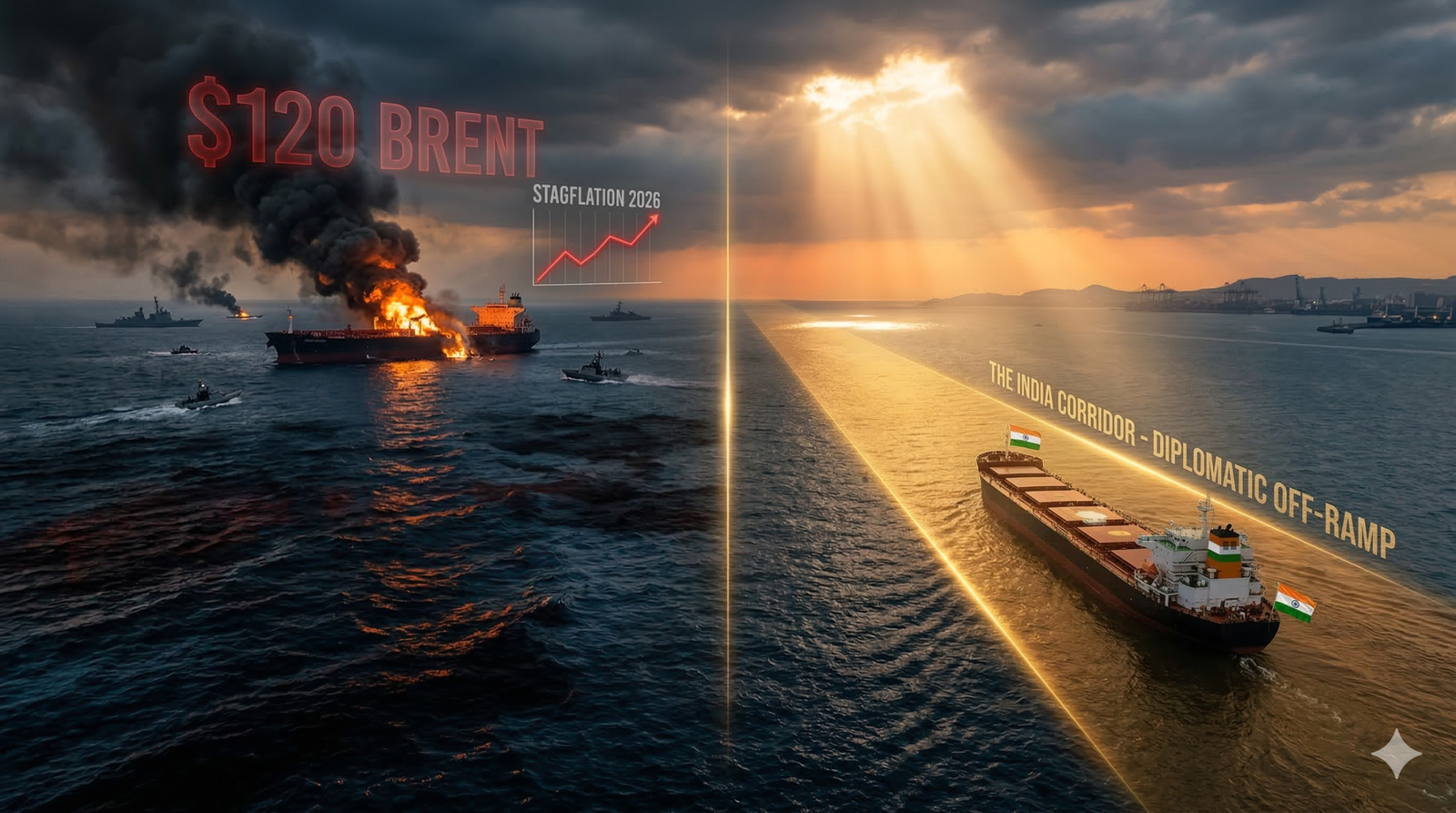
The inflation we thought was dead has been reignited. As of March 2026, the Strait of Hormuz has become a global powderkeg. With oil flirting with $120 and the specter of 1970s-style stagflation returning, investors are panicking. But amidst the chaos, a quiet diplomatic masterstroke by India has opened a slender corridor of hope. Is this the signal your portfolio has been waiting for?
The Geopolitical Gamble: Trump’s Force vs. India’s Diplomacy
The Persian Gulf has not been this dangerous since the 1980s. Following coordinated airstrikes in late February 2026, the Strait of Hormuz was declared closed. However, India—the world’s third-largest oil consumer—has secured informal assurances for its vessels.
The fact that Indian tankers like the MT Pushpak are still sailing is a crucial data point. It proves the strait is NOT yet fully mined. This selective passage suggests the crisis is being used as a political lever rather than a weapon of total economic destruction.
| Metric | Value | Note |
| Pentagon war costs (6 days) | $11.3B | ~$1B/day burn rate |
| Brent crude (March peak) | $120 | 40% surge in 2 weeks |
| U.S. recession probability | 38% | Prediction markets |
The Economy: When $120 Oil Meets a 1.4% Growth
The U.S. economy entered 2026 limping at 1.4% GDP growth. Now, $120 oil acts as a massive tax on every sector—from logistics to plastics. More concerning is the “de-anchoring” of inflation expectations, which jumped to 4.2% in February. When the public expects permanent inflation, the Fed’s standard tools lose their edge.
The “Four-Lock Problem”: Why Rates Won’t Fall
The consensus for rate cuts has evaporated. We are now facing the Four-Lock Problem:
- Supply-Side Inflation: You can’t fix a closed strait with rate cuts.
- De-anchored Expectations: Fear of permanent inflation is rising.
- War Deficits: Conflict costs roughly $1B/day, pushing Treasury yields higher.
- The ‘Transitory’ Scar: The Fed won’t risk cutting too early after the 2021 mistake.
2026 Investment Survival Playbook
The right framework now is Asymmetric Exposure—surviving the stagflation while participating in a potential de-escalation.
| Asset Class | Strategy | Recommended Sectors |
| Equities (Defense) | Overweight | Energy Majors (Exxon), Defense (Lockheed Martin) |
| Fixed Income | Short-Duration | 18-month T-bills, TIPS |
| Alternatives | Essential | Gold, Indian Energy Refiners |
| Risk Assets | Underweight | Long-duration Bonds, High-multiple Growth |